Adina Bar-On, an Israeli performance artist, active since 1973 to this day. In her performances, Bar-On requests to create or to restore concentrated and charged moments in life, in order to raise an awareness and emotional involvement on behalf of the participant-viewer. She creates these moments of emotions with her presence, her body, and her flesh. Her works are not simple to view, and might cause unease due to a sense of raw exposure to one’s inner most space; a sense of the bizarre, strange, borderline (in 1973 Bar-On presented her first performance at Bezalel Academy of Art and Design. The psychologist of the academy was requested by Bezalel’s administration to view the performance, and submit his professional opinion on Bar-On and her work). Bar-On is aware of the demanding quality of her work, and ties it to the nature of her work with emotion:
“A person works with material. To me, emotion is material. But what do people usually do with emotions? They usually direct them elsewhere: […] They do not really know what to do with them, especially in relation to art. […] In relation to art, we are used to an expression of emotion as an accompaniment to form and content, like an actor who speaks words, yet uses the quality of his voice, his breath, his movement to charge the words. But I just blink, flicker, divert, breath, swallow. For me these are all movements, complete forms, content. The problem is that we are not used to reading this language.”
In Bar-On’s works, from its start, there existed the components of work with space, creation of atmosphere, audience involvement, communication, and the search for the humane. Her tools are the body and its movement, the facial expression, the eyes, and the voice. In her earlier work, voice is only alluded to, as Bar-On sings to herself and hums. In later work, the voice takes on a more and more central role. Her work Sacrifice (“Akeda”, Efrat Gallery, Tel-Aviv, 1997), which evolved from 1990 onward, is based mostly on “abstract” voice – this is what Bar-On terms “vocal work” which does not rely on text – but its material-instrumental presence stands out in other works, as well, as in Breath (“She’ifah”, Tel-Aviv Museum of Art, 1995), and Dreamy (“Ha’lommi”, the Heder Gallery, Tel-Aviv, 2005). Following the non-verbal vocal expression, Bar-On adds to her performative toolbox the annunciated text, for example in her work Disposition (“Hittmats’ut”), performed in Israel and worldwide since 2000.
Bar-On’s intuitive transition from body to voice, from image to sound, is an interesting one. Antonin Artaud’s sensory language of theater – what he has termed “poetry in space” – is constructed from everything which occupies a place, and appears materially on stage: music, dance, body gestures, objects, lighting, the scenery. Influenced by Balinese theater, in which he saw an alternative model, Artaud aspired to a pre verbal state, a state which can have a language of its choice: music, gestures, movements, words. One can see each one of these “languages” as language of pure gesture, embodying the deepest concepts of mind and spirit, in what Artaud calls: “the fibrous interlacing of matter” – be it malleable material on stage, physical gestures, vocal gestures, music, and so forth. The actor’s voice and body is likened to a set of emotional muscles with which one works as if he were an athlete. Through them, he attributes concrete characteristics to emotions. This is the reason that this collection of components can work together, and comprise a whole; material and abstract at the same time. This is also the reason why Artaud’s theoretical framework seems to be appropriate to the world of performance art in general, and the relations and transitions between image and voice within the world of performance, in particular.
What occupies Bar-On is the pre-verbal material. The material embodied physically in the medium, which, at the same time, precedes the form and content enabled through the medium. Bar-On never planned to work as a voice artist, neither did she perceive herself as one. Her work as a performance artist developed from painting, as did the visual aspect of her movement in space, body gestures, and facial expressions, which became the main tools in her work. Nevertheless, Bar-On emphasizes: “The process of creating the work, as well as the performance event itself, do not evolve with the intention of being beautiful or aesthetic, but as a consequence of their ability to communicate.” Perhaps because Bar-On can paint, but has no musical training, the desire to present the materials of emotion themselves without the mediation of a formal setting, is especially clear when she makes the transformation to the use of her voice. “Here, the separation between aesthetics and art, occurs by itself”, she says, “The voice does not ask to create something beautiful or harmonious, but instead, it happens, acts, feels, defies.” Bar-On speaks with admiration about voice artists that are trained in music, perhaps because they hold something she does not: “I don`t read notes, and I am not knowledgeable in musical rhythms. There is something primitive in my approach to music. For me, music comes from the guts”. In her opinion, her work is more raw, and less polished than voice artists; Though her lack of musical education has provided her with an advantage in the type of vocal performance she creates.
Diegetic Expression
Sacrifice is a work which “accumulated”, so to speak, throughout the years, while Bar-On was invited to perform it in different venues in Israel and abroad. In 2005, it was even recorded as a purely vocal piece – as such, the vocal piece is even more complex than it is when performed live. The written description of performances, and surely those which include significant voice work, is nearly impossible. In light of this reservation, I will try to communicate something of the performance’s essence.
Sacrifice, Beit Tami, Tel Aviv, 1999
Adina walks in, and takes center stage. She is wearing a blue-green, classic cut, knee length dress, opaque black socks, and black high shoes. There are no other props, objects, or space sets. During the 20-minute performance, Adina remains standing in the same spot.
Part 1 (approximately 4 minutes): During several moments of silence, Adina situates herself in front of the audience, and sways her head slowly from one side to the other, as she moves her gaze upon the participants. She starts with an unvoiced-voice: one palm placed in front of her face, as if waiting to receive the voice, a high pitch begins to break through her throat. Adina is singing a melody, and it feels as if she is singing it in an inexact pitch (supposedly slightly off key), in an undefined rhythm, in glissando in the melodic skips. Within the inconsecutive contour, a repeated motif occurs several times between significant silent pauses, between one vocal projection and another (see motif transcription, image 2). In the third and sixth (and final) appearances of this motif, Adina continues the melody, and the impact is that of a rising lament, a pleading character of the singing, which is almost prayer-like. The right-hand palm continues to move all throughout the performance, in round, cyclical movements, in front of Adina’s face and especially the mouth. It is drawing her gestures, in the air which correspond magically to her voice, as if sculpting forms into space.
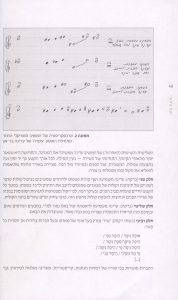
Part 2 (approximately 1 minute): Adina pronounces a gibberish of childlike patter, that seem to mix infantile pre-verbal sounds and adult voices, who are attempting to induce a baby to talk like them. During this entire sequence, the hands work around the face, especially the mouth, adjusting to the voice and joining the intentionally exaggerated facial movements, necessary for producing these qualities of sounds. Slight bursts of laughter are woven into the sounds.
Part 3 (approximately 1 minute): Adina sounds a deep bass voice for the first time, with oration-like mimicry, and interwoven with short, very high pitched, exclamations of surprise, which pierce the bass tones.
Part 4 (approximately 2 minutes): An energetic “song“, with characteristics of a march, clearly enunciated syllables, but meaningless:
Ofeh Neefa/ Heyfah Me’nee/
Heyfah Meyfah Mipah Neema/
Heyfah Neema Fey/ Heyfah Neema/
Fey Mah Meefeyney/ Heyma Fehnee/
[…]
The syllables are sung by an array of characters, caricatured, which Adina personifies intermittently: a man orating a speech, someone explaining something to the audience, a staccato voiced character shaking his/her hips, a child or an old woman. Here too, as in the introduction, one can recognize the clear contour, but the pitches are inaccurate intentionally.
Part 5 (approximately 5 minutes): A collage, in which several components appear intermittently: phonetic speech, screams, child’s babble, crying and a baby’s grumbling, and references to the melodic material which opens the performance. This part ends with a prominent pause.
Part 6 (approximately 4 minutes): A collage made up intermittently of a woman’s cries, helpless shouts and screams, a baby’s cry, references to the characters and to the march appearing in the fourth part, prominent pauses, and references to the melodic material which opens the performance.
Part 7 (approximately 2 minutes): An ending, which contains the melodic material that opened the performance.
From an interview with Adina Bar-On, Jerusalem, 1.10.2009
- Adina: When I created Sacrifice I didn’t even think of it as valuable in terms of sound; I didn`t think that something I do with my voice has any value in itself. People were saying repeatedly “but this is music”. Voice is something very physical to me. I sense the sound as something raw, as a substance in space. I hear what I do, but the sound becomes defamiliarized. I produce the voice as physical material. I think of it in an almost painting-like manner, the plasticity: the resonance of sound, its expansion, evaporation; This is can also apparent in the way I produce the voice.
- Yael: There is a strong sense of connection between your facial expression as you produce the voice, and between the plasticity of sound that you speak of. Are you aware of this? Did you consider this?
- Adina: I do not think of the way I look, but only concerned with the sounds I am extracting, which are created of themselves. In any case, the face is prior to all [also to the voice]. Though, when you think of it, the voice and the face, physiologically, are probably one entity.
- Yael: If I were to ask you to choose a side to belong to: voice artists that work with texts, or voice artists which work with a computer as a tool. Which side would you choose?
- Adina: I’m closer to the computer people.
- Yael: Why so?
- Adina: Because I use my body as a tool. And I don’t work with it to process something else. I think I produce myself. I am a tool; I am a medium. Of my own. I search for ways to produce these voices. I don’t interpret something preexisting; I do not make an interpretation to something that is existing. There is no processing. I bring forth the thing itself.
- Adina: The sound is part of my movement, and the viewer grasps this within the environment; The resonance bounces off the walls and floor.
- Yael: Do you work in a specific space prior to a performance?
- Adina: Yes. In the days and hours prior to a performance I work in the space, adapting the voice work to the specific space; in fact, I create a sound installation in the space. I never create a voice work without working in the space beforehand. I check how the voice works from different angles, and I try to think of it as the receivers – the participants.
“We live in Tel-Aviv”
Artaud’s transcendent dialogues spoken in theater are replaced by the aspiration to express emotional contents that are beyond the reach of language, and in this manner, are pre-lingual, primal, making use of everything which is physically present on stage. Only, there may not be only voice on stage, but also the spoken word. How would one use it?
Artaud demonstrates his awareness of this issue in several articles. This is not a case of total dismissal of speech in theater, he says, but in its repurposing, and reduction. It is not to be used to insure an understandability of purpose to which the characters aim towards, but to see it as an additional physical means that can be placed on stage. Speech ought to be activated as an object would; to be used tangibly and spatially, in order for it to be merged with the contents of the theater space. Words have the ability to create tone and melody in the way they are uttered, without relying on their meaning, and even in opposition to it. This quality should be used to express in language the things it usually does not.
Disposition (“Hitmatzout”), Neve-Tzedek, International Art Biennial, Tel-Aviv, 2009 – the first four minutes
Around 20 people gather in a designated meeting place, in Neve-Tzedek, Tel-Aviv. A man holding a long stick, with a white flag tied at its end, is waiting in the meeting place. He leads us down a small, busy street and Adina appears on the sidewalk across the street, also holding a white flag tied to a long stick. She is dressed in a red dress, a red scarf on her head, wearing black socks, and black shoes. She is walking toward us, we cross the street with her, and gather with her in the shade of a tall, densely leaved tree. Adina sits on a low fence between the tree branches, as she observes the viewers-participants’ faces. As she climbs off the fence and crouches to the ground (see image 3), she starts to speak. Her speech is prepared and planned in detail:
“We’ve been living in Tel-Aviv | for 23 years now. [Pause]
We invested a long time | in trying to decide | thinking | and in experiments in living in different parts of the country
Until we came to the conclusion that we really wanted to live in Tel-Aviv. [Pause]
We bought an apartment in one of the old buildings, in the city, and renovated it.
Adina slowly rises, extends her arms to the sides, gently holds the tree’s branches, observes them, and continues to speak:
This is the Alinthus tree. It’s also called the Tree of Paradise, and it was imported from China.
It is amazing!! [Pause]
Because it just planted itself so naturally |
And it really does not require ground at all. [Pause]
And minimum water. [Pause]
And in five six years it reaches this situation”
- Yael: How do you separate between speech and abstract voice?
- Adina: Also of the text, I think as an element in itself; It serves, to me, a purpose within the whole. When I do use text I am very attentive to the words. When I don’t use words, but use “voice”, I can be more attuned to other contents. In texts, I don’t paste the various segments, but I make a collage of them. This is done in sound art. Cage uses the sound of a thorn; later, he will play with the microphone. Then he will take the sound of dripping water, combine it, will work with the layers of resonance, with the volume, to create an inner space within it. I do the same, and have become more and more aware.
- Yael: This is in terms of the texts’ contents. And what about the quality of voice when you speak?
- Adina: The words and the quality of voice – the intonation, the tonality – appear together. When I put together a text, I work from the knowledge of intuition, perhaps in a manner similar to writing poetry, only I work while speaking. I do not write the text; I only speak it, until it sounds right to me – in terms of the words, and in terms of how I speak them; until I feel it is right, and perhaps also understand that it is right. This way I am able to memorize the text, as well.
Segments of texts are stored in Bar-On’s memory as content and as vocal material in one. They each stand apart, as objects of meaning, and thus their plasticity adjoins their content. The fact that she gives to them expression, so precisely, and meticulously in specific locations, chosen in advance, and combined with the created imagery through positioning of the body in relation to the environment – all these, turn speech into an occurrence in space, “the fibrous interlacing of matter”, to use Artaud’s term. The logical gaps (as she says) between the thing – what Bar-On terms as “the between the lines” – and the physical gaps between the elements, which are dispersed in time and space, activate the viewer-participants’ consciousness, as they are in search for the connection. Their thought wonders between the understandable and non-understandable: For the most part, they understand the language in which the words are spoken, while immersed in a state of “not fully understanding”.
And yet, aren’t the words predetermined, like a musical score, as something that needs only to be performed? While in Disposition (Hitmatsout) the text is not a set one, and it is recreated for each location`s context, it is not improvised and even includes core biographical parts which will be repeated each time the piece is performed. If we return to the execution of Pierre Boulez’s sonnet which we opened with, Tudor Baetu too, surely, does not improvise, as do any of the performers of Cage’s work. The altruism in Cage’s work – the space of choices he allows the performers – has nothing to do with improvisation. This collection of instances, perhaps because they are so “difficult”, shed a particular light on the deep, elusive idea of a theater, self-producing out of a negation of distinction between texts – whether verbal or of a musical notation – or performance. Texts are texts; but they are fashioned so that in their performance a sense of vocal matter, neither interpretative nor referential, but rather as the thing itself. The theater merges with its ways of production, says Artaud. In this sense we can say: The text merges with its manner of production – with the physical production of sound (in sound work), or with the physical production of tone (in music).
An interview with Yossi Mar Haim:
- Yael: I like thinking of Bar-On’s voice work in the context of sound-art. What do you think?
- Yossi: I worked with Adina* many times. At some point, she stopped working with pre-existing music, and decided to move to the use of her own voice. What, in fact, happened? The ability to perform moved to her voice, which is very interesting. It is sound-art, because she does not build some musical structure with elements we know, like volume, pitch, duration, but instead goes for the instrument of her own human body, her voice and her intuition; she creates what is best termed as sound-art.
*Mar Chayim wrote music for several of Bar-On’s works, amongst them “View” (Yanko Dada Museum, Ein Hod 1997) and “Rest” (Tel Aviv Performing Arts Center and Dizengoff Mall, Tel Aviv 1999).
- Idit Porat. Adina Bar-On: Performance Artist. Tel Aviv: Hakibbutz Hameuchad Publishing House, 2001. Page 142
- Bar-On’s reference to her own work throughout the article is based on an interview with Bar-On, Jerusalem, 1.10.2009
- Antonin Artaud. The Theatre and its Double. New York: Grove Press, 1997. Page 62
- ibid. In Artaud’s work, this physicality is tied with concepts like violence or theater of cruelty. It is, most likely, what Boulez aims for in the article which influenced Tudor, when the latter speaks of music in, what can be paraphrased as “modern in a violent way”.
- For Artaud’s concept of sensory abstraction, see ibid.
- Unconventionally, in this performance Bar-On stands on stage positioned front, as if this were a concert. The lack of movement in space, which exists in other performances of Sacrifice (and in Bar-On’s work in general, which could take place in any kind of space, not necessarily in a performance space), provides totality to the voice in this specific performance of the piece. For this reason, Bar-On sees it as a kind of prototype on which the other performances are based.
- Artaud, ibid. The word, speech, and vocal expression in Artaud’s world, is discussed in several contexts. See: Edward Scheer, (ed.), Antonin Artaud: A Critical Reader. London and New York: Routledge, 2004.